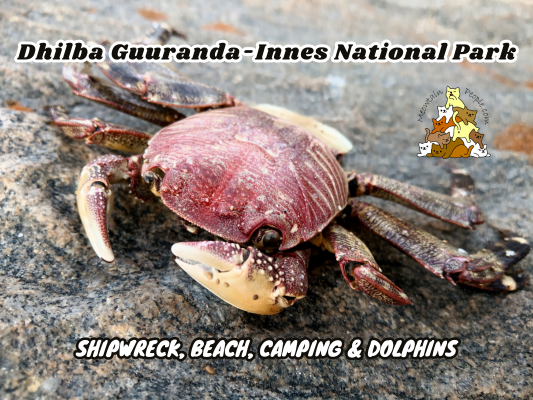
Dhilba Guuranda-Innes National Park is a top spot for camping, fishing, and surfing. It is located at the tip of the Yorke Peninsular, a beach-goer’s paradise a few hours’ drive from Adelaide. A vehicle entry fee applies to enter Dhilba Guuranda-Innes National Park.
Dhilba Guuranda-Innes National Park

There are a variety of attractions in Dhilba Guuranda-Innes National Park. One could go for various bushwalking trails, and camp at one of the seven campgrounds around the park, all accessible by a car (no 4WD required). If camping is not your cup of tea, there are also historic buildings turned into lodges in the Inneston historic township. Surfing at Pandalowie Bay and fishing are also popular here, just make sure you check the local regulations and not to fish at the protected sanctuary zone.
There are over 40 shipwrecks along the coast, and one could scuba dive to explore some of these underwater shipwrecks. However, if you are not scuba diving, you can visit the two onshore shipwrecks of Ethel and Ferret by foot at Ethel Beach.
Ethel Shipwreck & Ferret Shipwreck

The onshore shipwreck of the Ethel sailing ship (barque) can be seen above from the car park of Ethel Beach.

Stairs lead down to the beach for a closer look at the shipwreck.

Ethel was driven onshore by strong winds and giant swells in 1904, when the sailing vessel passed too close and struck a reef due to a south-westerly gale and poor visibility.

The wreck is not always visible, as shifting coastal sands slowly expose or rebury (especially in winter or after a storm) the wreck.


On the right side end of the beach, there is a little cave. I saw many footprints of birds in the cave.

Over at the left side of Ethel Beach, you could find the remains, a partially buried boiler of the Ferret steamship. Coincidently, it was the Ferret that first saw the stranded Ethel back in 1904, raised the alarm and led to the rescue of the Ethel crews.
In 1920, as the Ferret passed through the area, sudden thick fog and rough sea battered and holed the ship. The crew had to abandon the ship, but first they needed to anchor a lifeline to the beach. Ironically, the anchor point was the wreck of Ethel, which the Ferret encountered 16 years ago. The cargo washed up on the beach was mostly alcohol, much to the locals’ delight. At one point, a local constable had to patrol the area and smash any bottle of alcohol found washed up on the beach.
Shell Beach Campground | Dhilba Guuranda-Innes National Park

Shell Beach Campground (booking needed) is a nice spot to spend a night at Dhilba Guuranda-Innes National Park. It is a short walking distance away from two of the best beaches in the park: Shell Beach and Dolphin Bay.

Access to Shell Beach not far away from the campsite.


The sandy stretch of Shell Beach at a glance.

While the beach is mostly sandy, a small part of it was hard solid rock floor. It’s nice to stand on it and feel the cold waves but it can be slippery.


The soft sand was very nice to walk on, but the sand was very hot under the sun and I had to walk into the water or wear my slippers at some point.

As you walk to the right side of the beach you’ll reach the area with some rocky area out into the sea. Based on Google Maps there is a nice rock pool somewhere among the rocks.


Probably due to the rough tides or unsuitable tide levels, these are the only potential rock pools I was able to find.


True to its name, Shell Beach does have a lot of shells scattered around, especially at the rocky sections.

Abalone shell.

This one looks like the headcrabs from the video game: Half Life.


An assortment of beautiful finds among the rocks.


Picnic and sunset at Shell Beach.
Dolphin Bay / Dolphin Beach

Dolphin Bay can be accessed by a short climb over the hill on the left side of Shell Beach (near the car park). However, the bushy path was kinda ambiguous and you risk running into snakes and spiders. Alternatively, you can walk or drive on the road to Dolphin Bay.

If you climb the hill from Shell Beach to Dolphin Bay, you’ll first arrive at the rock floor section of the beach.

Dolphin Bay is another beautiful sandy beach, and it’s frequently visited by a pod of dolphins.

On the left side of the beach is the main access staircase from Dolphin Bay car park.

Further to the left are some big, elevated smooth rocks where you can sit and try to spot the dolphins.

In the morning as I strolled along Dolphin Beach, I spotted a pod of dolphins far away. swimming slowly along the coast.

As I left the park and drove by Minlaton town, I stopped by HJ Cook Fauna Park, the town’s little enclosed wildlife reserve, to see some emus over the fence.
Have this guide helped you? Tag @meowtainpeople in your hiking stories & posts!

*Captain Planet passing by* Remember, please take care of our environment, and please don’t destroy the Nature. Leave no trash behind and take back only photos and memories (and also some trash if you can). Walk on the designated path and stay in the middle as much as you can, so that the exposed soil doesn’t spread/corrode further. BE ONE WITH NATURE *flies away*
Affiliate Links to support this site:
Yay for transparency!: The links above are affiliate links, and at no additional cost to you, I earn a commission if you make a booking/purchase after clicking the links. I recommend only products and companies I use. Your support helps me keep the site going 🙂
Want to do the same affiliate marketing with your site? Use this AccessTrade platform link to receive RM5 reward.