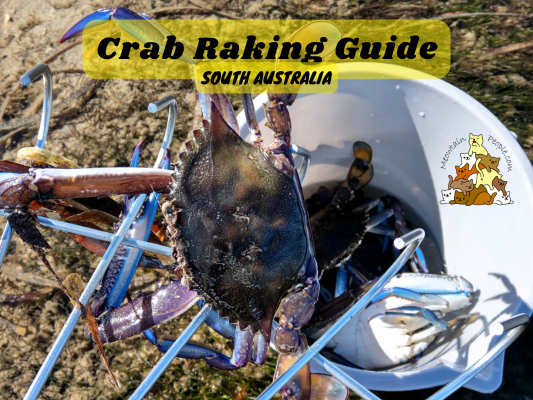
Crab raking to catch Blue Swimmer Crabs is one of the fun activities in South Australia. While there are other ways of crabbing, such as using crab pots (baited crab nets) placed at the side of jetties or on a boat, raking for crabs with a crab rake is a more active, engaging and rewarding method to catch a delicious feed.

Crabbing In South Australia: Rules and Legal Essentials
Before you go for your crabbing activity, make sure to know the rules and legal requirements, and check the latest updates on the Department of Primary Industries and Regions website. Here are some of the important rules to make sure crabbing activities are sustainable:
- Minimum legal size: Measured across the shell from the base of the largest spines, the minimum is 11 cm. Watch the video on how to measure blue swimmer crabs. Undersized crabs must be released back into the water.
- Catch limits: The combined daily personal bag limit for Blue Swimmer Crabs and Sand Crabs is 10-20 crabs (depending on fishing zones) per person. Boat limits apply when three or more people are on board (commonly 30-60 crabs per boat).
- Females crabs with eggs: Any female carrying external eggs must be released back into the water immediately. The external eggs are located on the abdomen of the female crabs. Always check for eggs before bagging the crabs.
- Bait restrictions for nets: When using hoop or drop nets in marine waters you may use fish or fish‑based bait only. Meat, poultry or offal (any meats that do not come from the ocean) are not permitted in these nets. Same goes with fishing baits.
Crab Raking Gears: What To Bring To Rake Blue Swimmer Crabs


- Crab rake: This is a rake made to catch crabs.
- Crab gauge (crab measuring device): Measure every crab as soon as you catch it.
- Bucket / Tub / Crabs container: Filled with seawater to temporarily contain the live crabs. Some seasoned crabbers fit floats and wheels on their tubs with ropes attached to their body, so that they can have two hands on the rake hunting for crabs while dragging the tubs behind them.
- Water shoes / Waders / Old shoes: It is not recommended to go bare feet as there are usually sharp rocks, shells or razorfish in the crabbing areas. Furthermore, you don’t want the crabs to pinch your toes! Footwears also act as a defense against unintentionally stepping on highly venomous creatures, such as stonefish (though not present in SA waters), cone snails and blue-ringed octopus.
- Sun Protection: Long sleeve shirt, sun hat, face scarf, reef-friendly sun screen. Sunglasses are also important, not just for eye protection from the sun, but to reduce glare on the water to make it easier to spot crab hiding spots.
Best Time To Go Crabbing In SA
- Crab Season: While crabs are around all year long, they are more active and come to shallow waters to breed during warmer months. Crab season runs from September to April. An easy way to remember is that any month with an ‘r’ is a good month to catch crabs. However, for crab raking, it usually peaks in late summer and early autumn when the water is the warmest.
- Tides: Blue Swimmer Crabs are most active during tidal movement. Most people start raking at low tide and work the incoming tide back toward the shore. I usually head out into the sea before the lowest tide, walk to the furthest walkable parts at the lowest tide while raking for crabs, and start zigzagging towards the shore while raking as the tide is coming in.
- Weather Conditions: Weather plays an important role in determining whether it is a good day to go out raking for crabs. A hot sunny day means the crabs could be most active. Moreover, a warm overcast day with no wind is also great as the water would be clear to see through. On windy days, however, I will always cancel the crabbing plans because the water will be too choppy to see beneath the surface.
Where To Rake Blue Swimmer Crabs In South Australia
Habitats with shallow tidal flats with a mix of sand and weed beds, edges of seagrass meadows, and channels where crabs move with the tide are the best places to find blue swimmer crabs. These shallow waters are typically in very wide and flat areas, spanning from 1-3 kilometers away from the beaches. You could walk 30 minutes into the waters away from the beach, and still find the water level to be below the knee.
Some of the popular and best places to go crab raking are the tidal flats between St Kilda and Port Parham: Thompson Beach and Parham Beach being the two most popular crabbing spots. Other than that, the tidal flats in Yorke Peninsula, such as Tiddy Widdy Beach in Ardrossan, are known to be great crabbing spots.
How To Rake Blue Swimmers Crab & How To Find Them

Here’s an example using Google satellite image of Thompson Beach’s tidal flats, to show you the crab raking spots. The red lines indicate one of the tide channels. These channels serve as a ‘highway’ for crabs to swim into the shallows, or out into the deep. As tides come in, the crabs will often enter via the channels into areas such as the one circled in blue (estimated), to find mates and to breed. Both the red lines (channels) and the blue-circled areas are good spots for higher chances to find the crabs.
You will find the crabs either swimming in the open, or hiding underneath the sand. Spotting swimming crabs are straightforward since they are out in the open.

For crabs hiding under the sand, they can also be quite obvious, as you can see the difference in the color of the sand. As the crabs dig into the sand to cover themselves, they push the deeper, darker sand onto the surface or the sea bed. So, look out for patches of darker sand, and there might be a crab in one of those spots. Moreover, the edges of weed beds and seagrass meadows are good places to look for these dark patches of sand (hence the outline drawn for the blue circle above). Avoid trampling or walking into the seagrass beds, as these are vital habitat for many marine life and feeding ground for birds. As you walk across the sand in the water, you may find some boggy areas, where your legs sink deep into the soft/muddy sand and struggle to pull them back up; Avoid these parts too, as it will be too slow and draining to walk on them.
Now that you have spotted a crab, or potentially one hiding under the sand, how do you catch it? Here comes the fun part, using the crab rake!


All you have to do is to drag the rake across the crab or dark sand patch, let the crab ‘attack’ and grab the rake with its claws, and then flip the rake over while the crab is still hanging onto the rake.
For crabs hiding under the sand, slowly pull the rake across the dark patches. If there is a crab underneath, it will launch its claws up and grab the rake. Then, do the same action of flipping over the rake once it gets a grip of the rake. Watch the below video of me raking crabs, notice the dark sand patches (crab indicators) before I rake them over?
You might need to rake the crab a few times as it tries to escape, but it would usually hold onto the rake once the crab gets a grip on it.

After measuring the crab to ensure the minimal size requirement is met, you can shake the rake to try to drop it into the bucket, or grab the back of the crab with your hand, where it’s safe from its pinchers.

If you’re not confident handling crabs for the first time, use a pair of tongs as you learn their movements and the pinchers’ reach.
How To Humanely Kill Crabs To Clean & Cook Them


Stunning followed by spiking is an effective and humane method to end the crabs life before preparing to cook them. Spiking / Double spiking is a method used to rapidly destroy the central nervous system of crabs using a sharp pointed object. It works well on crabs as they have two large nerve centers that are easily located and accessed using a sharp-pointed knife (like a filleting knife) or a screwdriver. The hind nerve center can be destroyed by opening the flap under the crab and spiking into the tiny hole in the center of the abdomen (demonstrated in the video below). A second spiking to destroy the front nerve center is done through the front right between the eyes.


With crabs freshly caught from the sea, just a simple steamed crabs with its original sweet flavor is so good!
Have this guide helped you? Tag @meowtainpeople in your crabbing stories & posts!



Affiliate Links to support this site:
Yay for transparency!: The links above are affiliate links, and at no additional cost to you, I earn a commission if you make a booking/purchase after clicking the links. I recommend only products and companies I use. Your support helps me keep the site going 🙂
Want to do the same affiliate marketing with your site? Use this AccessTrade platform link to receive RM5 reward.